You Can't Scale What You Can't Measure
What Is the Blind Spot in Your Reports Costing You?
If leadership doubled your budget tomorrow, where would the first dollar go, and how would you know it worked?
Most marketing leaders can say where the dollar goes. How they would know it worked is where the room goes quiet.
We heard a sharp version of this problem across two discovery calls with a marketing leader at a large B2B company. In the past, marketing there had almost no paid budget unless someone wrote a full business case for the return. A new CEO changed that. The mandate now is to invest and test, with a condition every revenue-accountable leader knows: the return has to be there.
Spend can scale a lot, they told us, if they can prove it works. Even the investment in building a team that knows what it is doing is, in their words, "a big sell on my side," because marketing used to run on almost nothing.
So the budget waits on proof, and proof waits on visibility.
What happens when you see only part of the picture?
On the first call, they laid out the visibility problem. Their cookie policy hides most of the real traffic from their analytics. The customer journey has breaks in it. There is no landing page clean enough to show where a visitor came from, and the link between ad activity and the CRM is a separate problem on top of that.
In their words, "the visibility on what is actually coming through, what is working, is so bad."
So they took the question to a wider marketing team inside the company:
"...how do you expect us to spend and scale wisely when I don't even know what's going on."
It is the right question. It also has an uncomfortable answer. You can't.
Why more spend makes the guess bigger
The trap is circular. Budget expands when marketing proves it works. Marketing cannot prove what it cannot see. So the next dollar goes in on instinct, and a larger budget placed on instinct is simply a larger guess.
This leader had already paid to learn that lesson. Test campaigns ran on channels they had only just started, and at the end they had no way to tell whether any of those ads turned into a lead. Their summary was blunt: "When we can't even attribute a lead to which creative they clicked on, we have bigger problems."
In enterprise B2B the gap compounds. Their sales cycle can sometimes run for years, and whether marketing gets credit for a first touch depends on how records are tagged in the CRM. A visibility problem at the top of the funnel becomes an attribution problem at the bottom, and the leader is left to defend spend with a partial story.
"I see us... wasting money at the moment," they told us. That is not a confession of failure. It is a competent operator naming a structural problem out loud.
A blind spot carries a price
Reported numbers miss real activity, and the gap is measurable. When AirSculpt ran a conversion lift study, it surfaced $2.3M in revenue from a single paid channel that their reported numbers were not tracking. A budget decision built on those reports would have treated that revenue as nonexistent.
The results from other clients are just as concrete. For SpotOn, revenue grew 21.9% while cost per unit (CPU) dropped 34%. For Legal Training Co, a lead generation business, booked calls rose 178% as spend scaled 2.5x.
Diagnose before you spend
This is why we lead with the Growth Diagnostic. Before a budget decision moves, a Growth Strategist works through the revenue system and answers the questions the dashboard cannot:
- Where the journey breaks: which handoffs between ad, site, form and CRM lose the thread.
- What the reporting misses: how much real activity sits outside what your analytics capture.
- What a new customer is worth: the most you can spend to win one and still make money, which is where nCAC starts.
- Which channel earns the next dollar: judged on contribution to pipeline, not on which platform claims the credit.
The diagnosis does not stop after the first readout. Every review call with your Growth Strategist runs as a diagnostic: what worked, what did not, and what changes next.
On the second call, Ralph Burns, our CEO, turned to the customers that matter most to this business: the large accounts behind most of its revenue. The goal, he said, is to attract more of them, and then:
"And how do you do that at a cost to acquire them that makes sense?"
— Ralph Burns, CEO, Tier 11
He added that the acquisition math can be worked out later. Attracting the right buyer comes first. But when that math does get worked out, it needs numbers you trust. The leader said spending well into five figures to win a single new customer would be a huge win, because a customer relationship there tends to last for years. You only know whether a given dollar earned that win if you can trace it.
Where the Data Suite fits
The Tier 11 Data Suite is the measurement layer behind the diagnosis. It captures first-party data on the server side at 99.4% accuracy and turns it into one source of truth. Your Growth Strategist pulls reports from it for every review, so decisions about what to scale come from the same numbers each time.
That source of truth ties spend to what leadership actually asks about: new leads, cost per booked call, pipeline, and what each new customer costs to bring in (nCAC). Above all of it sits the Marketing Efficiency Ratio (MER): all revenue measured against all marketing spend, on every channel at once. A single platform cannot inflate that number on its own.
The Growth Strategist running that work is senior, and stays with your account for the life of the partnership rather than handing it off after kickoff.
The discipline to wait
By the second call, the leader was leaning toward strategic consulting as the starting point, so that money would not go into campaigns they have no way to measure yet. As they put it, "the quick win is actually on developing the marketing function to work." That plan still has to win over leadership. The sequence behind it is sound.
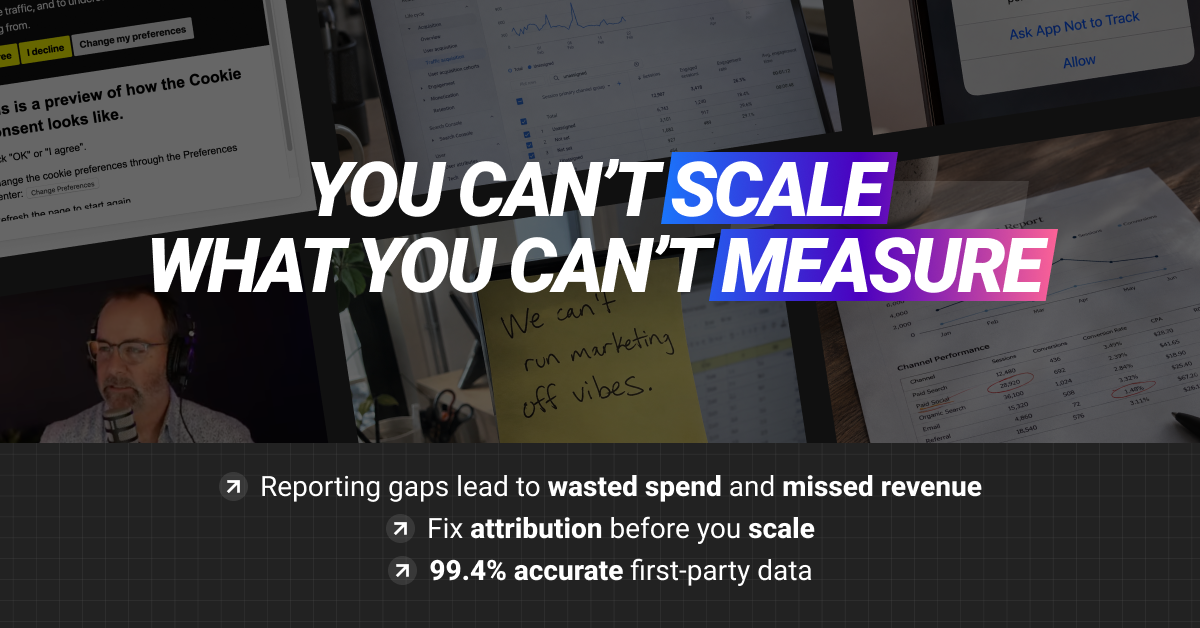
Talking about how decisions get made inside the company, they added a line every revenue leader should keep in view: "We can't run marketing off vibes."
If your budget arrived before your measurement did, that is not a talent problem. It is an order-of-operations problem, and it is fixable. Put the source of truth in place, then let the numbers decide which channel earns the next dollar.