

.png)
A global children's surgical-care nonprofit hired us to grow donations without letting costs climb.
In 12 months we brought in 10,177 new donors and 12,151 donations on $4.46M of ad spend, and held the cost per donation steady the whole way.
10,177 new donors · 12,151 donations · $4.46M managed media · cost per donation held between $313 and $421 while monthly spend swung nearly 5x
Nonprofit donor acquisition. Meta and YouTube. June 2025 to May 2026.
We did not win one big month. We scaled spend nearly 5x for the year-end giving season, then brought it back down, and the cost per donation barely moved.
Over 12 months we delivered 12,151 donations and 10,177 new donors.

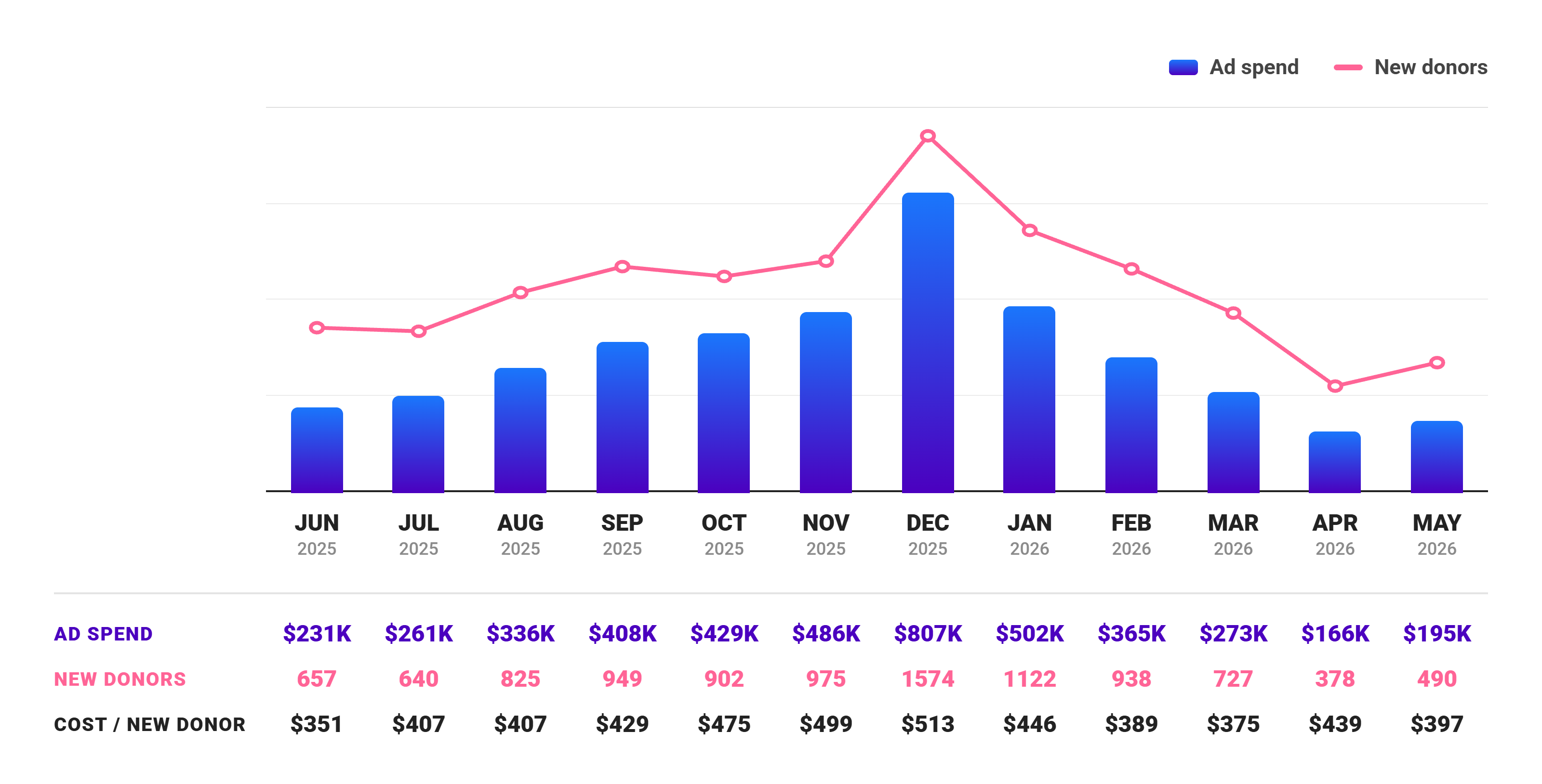
Most accounts get more expensive the moment you scale them. This one did not. We moved monthly spend from $165,894 in the slowest month to $807,441 at the peak, a 4.9x swing. Cost per donation stayed between $313 and $421 the whole time, a spread of just 1.35x. The account ran the same at $170K a month as it did at $800K.
That turns a budget into a plan. The nonprofit could commit to a giving-season ramp and know what it would get back, then pull spend down cleanly when demand dropped.
2026 is where we proved the account got better, not just bigger. After we moved to a two-campaign structure and tested persona-based creative, cost per new donor fell from its December peak of $513 to $375 by March. That is a 27% drop.
Cost per donation followed. March hit $313, the lowest of the year. May held at $315. Both sit well under the peak of $421. We were buying donors more cheaply in 2026 than at any point the year before.
We relaunched YouTube in May, and it came back as our most efficient channel: $252 per new donor, far below the $438 blended cost. The lever was creative and structure, not just budget.
We rebuilt the account into a clean two-campaign structure so we could test and scale faster. We built and tested persona-based creative to lower the cost of each donor. We ran Meta and YouTube as one system: scaling each when it paid off, pausing it when it did not, and relaunching YouTube at the best per-donor cost of the year.
We ran reengagement ads and tested landing pages to convert more people After-the-Click. And we judged every channel on blended, top-line results, total donations, new donors, and cost per donor, not on last-click platform reports.
That is how we knew where each next dollar should go.
Nonprofit math works differently. The first gift is small on purpose, so first-gift return on ad spend understates what a donor is worth.
The average one-time gift ran about $42 to $61. The real value builds through sustaining donors who give every month. That base grew from 133 in June 2025 to 315 in December.
Each sustaining donor is recurring income that pays back the cost of acquiring them. That is why we track cost per new donor and sustaining growth, not first-gift ROAS.
If your costs climb every time you raise spend, the problem is the system under the budget, not the budget. Let's talk.